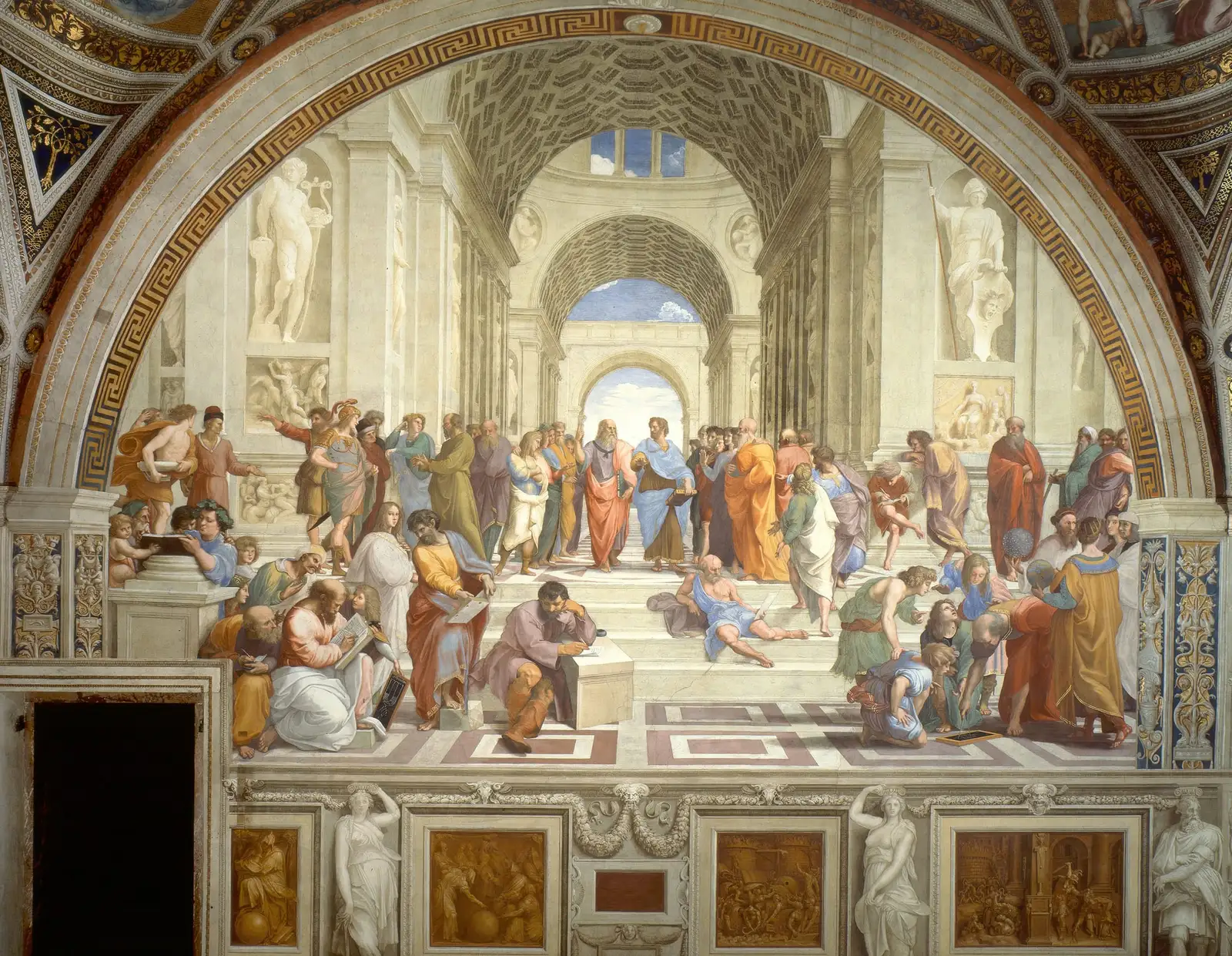
The Partition of the Abyss
Mereological Nihilism of Consciousness
Translated from the Portuguese original A Partição do Abismo

Mereological Nihilism of Consciousness
Consciousness is not a unity; it is an assembly of subconsciously conflicting parts whose emergent product — the coherent self — is the main source of suffering in the accessible universe, and the suffering of this self is structurally analogous to the suffering of the physical whole, which decays, because decay is the only truly universal law that matter knows.
Peter Wessel Zapffe once wrote that human consciousness is an evolutionary hypertrophy, a biological excess that turned against the very organism that produced it. The elk’s antlers grew too large; the tree of neurons grew too dense. Zapffe saw four strategies of psychic survival — isolation, anchoring, distraction and sublimation — as the mechanisms by which humanity manages, generation after generation, not to destroy itself en masse in the face of a clear vision of what it is. This essay extends that analysis. It goes further. It argues not only that consciousness has exceeded its biological usefulness, but that the very structure of consciousness — its mereological nature, the relation between the parts and the whole it simulates being — is the mechanism that generates suffering, and that this mechanism is mirrored, on a fractal scale, in the structure of the entire physical cosmos.
There is no way out. But at least we can understand the room in which we are trapped.
Part I: The Problem of the Parts — Mereology as the Ontology of Mind
1.1 What Mereology Tells Us (and What It Has Left Unsaid)
Mereology is the formal study of the relations between parts and wholes. It arose as a discipline in analytic philosophy with Leśniewski in the early twentieth century, and was developed by philosophers such as David Lewis, Peter van Inwagen and Ted Sider. The classical question is deceptively simple: when do parts form a whole? When do atoms of carbon, hydrogen, oxygen and nitrogen form a molecule? When do neurons form a thought? When do people form a society?
Van Inwagen, in his work on material composition, defended a radical position: composition occurs only in living beings. There is, strictly speaking, no “table” — there are molecules arranged in a certain way, which our mind groups under a functional concept. Mereological nihilism, the most radical position on this spectrum, denies composition in any ontologically robust sense: only simples exist, only ultimate and indivisible parts. What we call a “whole” is always a useful fiction, a narrative imposed by perception on a substrate that knows no unity.
Mereology, as a discipline, has applied these arguments chiefly to physical objects. What has rarely been done — with the seriousness the problem deserves — is to apply the mereological structure rigorously to consciousness itself. The question this essay raises is: what if the “self” is exactly the kind of whole that mereological nihilism denies exists? What if the unity of consciousness is, in the most precise sense, a fiction? Not a harmless fiction, but a fiction with suffered consequences, lived in the body and in the mind, felt as real pain?
This is not a new thesis in its components. Hume denied the substantial self; contemporary neuroscience has fragmented consciousness into parallel and partially independent processes; psychoanalysis introduced the idea of an unconscious that does not obey the narrative of the conscious self. But the synthesis — the claim that the illusion of unity is itself the central mechanism of suffering, and that this illusion mirrors the pseudo-unity we call “existence” — that synthesis has not yet been made in its full force.
1.2 The Self as Necessary and Destructive Fiction
Let us begin with the neurological basics, which is where philosophy must anchor itself if it does not want to float freely in consoling abstraction.
The human brain is not a unified system with a single decision-making center. It is a collection of partially specialized modules, systems that evolved at different moments of phylogenetic history, superimposed layers of processing — what MacLean metaphorically called the “triune brain” (reptilian, limbic, neocortex), although that metaphor is now considered oversimplified. What matters is not the anatomical tripartition, but the principle it suggests: the brain does not function as a deliberating unity, but as an assembly of processes competing for resources, attention and behavioral expression.
Michael Gazzaniga, working with patients whose corpus callosum had been severed — the famous “split brains” — demonstrated that the two hemispheres can have contradictory beliefs, preferences and even narratives about the same actions. The left hemisphere, which Gazzaniga called the “interpreter,” invents post-hoc stories to explain actions generated by the right hemisphere, which it does not control. The narration of the self, therefore, is not a faithful record of internal states — it is a confabulation.
Daniel Kahneman divided cognitive processing into System 1 (fast, automatic, affective) and System 2 (slow, deliberative, analytical). What subsequent research has shown is that System 1 governs the overwhelming majority of real behavior, while System 2 — what we identify with the “rational self” — frequently rationalizes decisions already made by processes to which it has no access. The conscious self is, to a large extent, a spokesperson for processes that did not consult it.
Jonathan Haidt formulated this as the metaphor of the rider and the elephant: reason (the rider) thinks it controls behavior, but is in fact carried by the emotional elephant wherever the elephant wants to go, inventing justifications along the way. What this essay adds to that metaphor is the following: the rider’s suffering stems precisely from its belief that it is a rider. The suffering would not be lesser if the rider disappeared — but it would be different, less reflexive, less cumulative, less able to feed back on itself in spirals of self-consciousness about the suffering.
The problem is not that there are multiple processes in the brain. The problem is that these processes have generated, evolutionarily, a narrative of coherence — the “self” — which constantly comes into conflict with the reality of its own multiplicity. The self suffers because it claims to be one and constantly discovers that it is not. And this discovery, when not repressed by the defense mechanisms that Zapffe catalogued, is the experience of psychological horror that different traditions have named in different ways: anguish (Kierkegaard, Heidegger), nausea (Sartre), despair (Kierkegaard again), or simply the brute, mute fact that there is something it is like to be this aggregate of processes, and that something is not pleasant.
1.3 The Subconscious as Unelected Legislator
The political structure that best describes the human mind is neither a democracy nor an enlightened monarchy: it is an oligarchy of factions at permanent war, where the official spokesperson (the conscious self) has less and less real power and more and more obligation to pretend it has some.
Freud saw this, but framed it in a way that made it palatable: the unconscious as the repository of the repressed, the id as pulsional chaos that the ego must manage. Freudian theory, at its core, still preserves the hope of a self that can, with enough analytic work, reconcile with its depths. That is consolation. That is the promise that the parts can, in the end, be integrated into a functional whole.
What the neuroscientific evidence suggests is darker: no final integration is possible, because there is no unifying principle that precedes multiplicity. The self is not a primary structure that was fragmented by trauma or civilization — the self is the fragmentation, it is the attempt at coherence retroactively imposed on processes that were never coherent.
Jung attempted the synthesis with the concept of individuation: the path to making the unconscious conscious, to integrating the shadow, to reaching the Self as realized totality. But note the structure of the Jungian argument: it presupposes that there exists a prior Self toward which the process of individuation converges. That presupposition is exactly what we need to question. What if there is no Self? What if there are only processes, and individuation is one more mechanism of anchoring — in Zapffe’s sense —, a useful fiction that allows the organism to function without collapsing under the weight of irresolvable multiplicity?
The subconscious — a term used here more broadly than the Freudian unconscious, including all cognitive and affective processes not accessible to direct conscious introspection — is the real legislator of mental life. It determines what attracts us and what repels us, what gives us pleasure and what gives us pain, which memories are accessible and which are suppressed, which narrative of the self is built and maintained. The conscious self does not choose these parameters; it inherits them, and then calls them “itself.”
Here is the structural cruelty: when the subconscious generates suffering — anxiety, depression, compulsion, phobia — the conscious self tries to eliminate it by the mechanisms within its reach. Therapy, medication, behavior change, rationalization. But these mechanisms of relief from immediate suffering often redistribute the suffering to other configurations, other temporalities, other parts of the system. The elimination of suffering in one part causes greater suffering at the macro level and in the long run — not through malicious deliberation by any system, but as an emergent property of a complex system in which the subsystems have incompatible goals that none of them chose.
The addict who uses a substance to eliminate immediate pain is not making a poorly informed rational decision — they are responding to a real pressure, generated by parts of the nervous system that identify, correctly from their local point of view, that the substance reduces suffering at that point in the system. The problem is that this local relief is bought at the cost of systemic damage that the parts responsible for the decision have no computational access to calculate. The evolutionary rationality of the immediate produces the existential irrationality of the long term. And this irrationality is not a correctable flaw — it is the structure of the system.
Part II: The Whole That Is Not — Consciousness as Suffering Pseudo-Unity
2.1 The Illusion of Agency and the Problem of Emotional Free Will
The Western philosophical tradition is, to a large extent, a persistent defense of free will. Kant needed it to save ethics. Sartre needed it to save the existentialist project. Christian theology needed it to explain evil without blaming God. All this conceptual machinery was built to preserve the intuition that the self — this aggregate we have just dismantled — is genuinely the author of its actions.
The neuroscientific evidence is well known and extensively debated: Libet’s experiments showing brain activity preceding awareness of the “intention” to move; the studies of Soon and colleagues showing that the choice can be decoded in patterns of cortical activation up to ten seconds before the subject reports having decided; the vast literature on the role of automatic processing in behaviors that subjects describe as deliberate. The debate over what these results imply for free will continues — philosophers such as Daniel Dennett work hard to save some compatibilist version. But the question that interests us here is not the metaphysics of free will: it is the phenomenology of the suffering that emerges from the belief in free will in a system that functions largely without it.
The deepest psychological suffering — guilt, shame, regret, anger at oneself — is structurally dependent on the belief in agency. You blame yourself because you believe you could have acted differently. You feel shame because you believe your actions reflect choices that a “better self” would have avoided. Regret presupposes a counterfactual: a different past that a different self would have produced.
But if the self is an emergent fiction of subconscious processes that do not deliberate in the sense the notion of agency requires, then guilt, shame and regret are sufferings based on false premises. They are not merely useless — they are ontologically ungrounded. They are the pain of a ghost who does not know he is a ghost.
This is not, it is crucial to note, an argument for impunity or moral antinomianism. It is a description of the mechanism by which suffering is generated. Suffering based on false agency is still real suffering — the ghost’s pain hurts as much as the body’s pain. But its structure is different, and its elimination requires a different diagnosis.
What is here called “emotional free will” is not classical philosophical free will — it is not the deliberate choice among alternatives weighed by reason. It is something more specific and more problematic: it is the capacity that the emotional and subconscious parts of the system have to act — to generate real behavior with real consequences — without the rational conscious self having taken part in the decision, followed by the conscious self’s confabulation that the decision was its own. The action is carried out emotionally, as the physical representation of the parts as a whole. The body acts; the self claims the action as its own; and then carries the weight of consequences it did not deliberately produce.
A man who, in a moment of anger, says something cruel to someone he loves did not choose, in the deliberative sense, to say it. The anger — an emotional process with its own logic, its own triggers, its own dynamics — acted through the motor apparatus. The conscious self, retrospectively, constructs a narrative: “I said that because I was frustrated with behavior X.” But the anger did not consult the conscious self. It acted first; the narrative came afterward. And now the conscious self — which was not the real agent — carries the guilt, the regret, the relational weight of the consequences.
This structure — parts acting, whole suffering — is the mechanism of psychological suffering generation par excellence.
2.2 The Physical Representation of Parts as Whole: Somatization as Ontology
The body is not merely the substrate of the mind — it is the stage on which the war between the parts is enacted, often before the conscious mind has a vocabulary for the conflict. Psychosomatics, for decades treated as a marginal or pseudoscientific field, has gained solid empirical foundations in recent decades: the work of Bessel van der Kolk on trauma, Robert Sapolsky’s research on the impact of chronic stress on physiological processes, the vast literature on the hypothalamic-pituitary-adrenal axis and its link to emotional states.
What this body of work suggests is that conflict between parts of the mind does not stay contained in the mind — it spills over into the body. Chronic muscle tension, dysregulation of the autonomic nervous system, altered breathing patterns, immune dysfunctions associated with prolonged emotional states — all of these are the parts manifesting physically. The body is the spatial representation of internal conflict, it is where the parts that cannot speak directly write their caption.
This has a philosophical implication that is often neglected: suffering is not merely a mental phenomenon or a narrative construction. It is material. It occurs in flesh. It has a determinate physical substrate — cortisol molecules, patterns of sympathetic activation, inflammation. And this physical substrate connects the suffering of consciousness to the suffering of the wider physical cosmos.
The body that suffers psychologically is suffering physically. And the physical body is subject to the same laws of decay as everything else in the material universe. The distinction between “mental” suffering and “physical” suffering is a convenient fiction — one more anchoring strategy, in Zapffean lexicon — that allows us to treat psychological suffering as if it were of a different nature from physical suffering, and therefore potentially resolvable by means that physical pain would not have. But the parts of the mind are written in matter; the conflict between the parts is a physical conflict; and the suffering generated is material suffering, integrated into the general decay that permeates everything.
2.3 The Factory of Meaning and Its Defective Products
Human consciousness — this whole-that-is-not-a-whole — has developed, over the course of evolutionary and historical process, an extraordinary and extraordinarily costly capacity: the fabrication of meaning. Moral values, existential purposes, life projects, religious systems, ethical structures, narratives of identity. All this production is, in the terms of this essay, defensive manufacturing.
Zapffe identified sublimation — the transformation of existential anguish into cultural product — as the most sophisticated mechanism for suppressing full consciousness. A poem, a cathedral, a philosophical theory, a work of art: these are, on this reading, anguish channeled into form. What Zapffe did not sufficiently analyze — because his inclination was pessimistic and his conclusion was for celibacy and voluntary extinction — is the specific structure of these products, what they reveal precisely by the way they build their defense.
The ethical system is the most revealing way of examining this dynamic. Ethics claims to be, in its most ambitious versions, a set of objective principles that govern human behavior according to values that transcend the individual. Justice, well-being, dignity, virtue. Each of these concepts, when examined closely, reveals the structure of a psychic defense — not a discovery about reality, but a projection of subconscious needs in the form of universal legislation.
Take Justice. The intuition of justice — that things should be in balance, that bad actions should have proportional consequences, that merit should be recognized — is psychologically powerful and almost universal among humans. It is also completely unsupported by the observation of natural reality. Nature is not just. The universe keeps no moral accounting. Children die of cancer; kind people are destroyed by circumstances; the wicked prosper with a frequency comparable to the good. The distribution of suffering in the universe obeys no principle of moral proportionality.
And yet the sense of justice persists, persists with immense emotional force, which constitutes evidence — in this essay’s interpretation — that it is a subconscious production, not a rational discovery. The subconscious, in its effort to manage existential anguish, fabricates the intuition that the universe is morally ordered, because a morally ordered universe is habitable in a way that an indifferent universe is not. The intuition of justice is not knowledge — it is anesthesia.
The same holds for happiness understood as an attainable totalizing state: the idea that it is possible, through correct choices, right mental dispositions or adequate external conditions, to reach a state of sustained and complete well-being. The promise of permanent happiness is the best-selling product in human history — sold by religions, by philosophies, by whole economies (consumer capitalism is, in its deep structure, a machine for selling promises of happiness in material packaging). And it is precisely as fictitious as the promise of cosmic justice.
What exists, at best, are moments — fragments of positive experience, intervals between suffering. But the “self” — this pseudo-unity that aggregates experiences into a narrative — cannot tolerate the fragmentation of positive experience. It needs to construct a narrative of progress, of accumulation of well-being, of approach to a fullness that would justify existence. This narrative is fabricated by the subconscious parts that need goals in order to function, horizons in order to coordinate behavior. And the fabrication is so well made, so convincing, that the conscious self takes it for a discovery.
Knowledge is different. This is the crucial distinction that this essay needs to mark clearly. Knowledge of how nature works — chemistry, physics, biology, mathematics — is not of the same kind as ethical values and existential projects. Objective knowledge is possible because it is impersonal: it does not depend on the narrative of the self to be valid, it is not fabricated by the subconscious to manage anguish, it does not need a coherent self to be true. The law of universal gravitation is true regardless of who observes it, of their emotional states, of their narrative needs. The map of the human genome is real regardless of what the geneticist needs it to be.
This is not a concession to Platonism — there is no “realm of objective truths” separate from the physical world. It is a distinction between kinds of knowledge by their mode of generation: scientific knowledge is generated by processes that systematically try to eliminate the contribution of the self from the result; ethical and existential knowledge is generated by processes that are themselves expressions of the self and its defensive needs.
Science is, paradoxically, the only product of consciousness that strives to free itself from the consciousness that produces it. It is the only form in which defensive manufacturing can be identified and, to some extent, controlled. This does not make it more “meaningful” in an existential sense — it, too, cannot offer what ethics and metaphysics promise. But it can offer truths about what exists, and truths about what exists include the truths about decay, about the cosmos’s indifference, about the nature of suffering — the very truths that the factory of meaning works incessantly to obscure.
Part III: Decay as Universal Law — From the Atom to the Subject
3.1 The Second Law as Ontology
The second law of thermodynamics is the most philosophical of the physical laws, although it is rarely presented that way. It states that, in an isolated system, entropy — the measure of disorder, of random distribution of energy — tends to increase. Spontaneous processes follow the entropic gradient: order dissolves into disorder; structure dissolves into chaos; differentiation dissolves into homogeneity. The arrow of time, in its single irreversible direction, points toward increasing entropy.
The universe as a whole is a closed system (by the best current estimate) tending toward thermodynamic equilibrium — what physicists call “heat death”: a state of maximum entropy where no energy gradient makes work possible, where no complex structure is possible, where no difference between this and that exists. The “heat death” of the universe is, in a technical and not metaphorical sense, the death of everything: of all structures, of all processes, of all the differentiation that is the condition of any experience.
This law is not a theoretical abstraction. It is lived. It is what you see when a building is not maintained: the house decays, the walls crack, the structure collapses into distributed materials. It is what you see in the human body over time: the skin that loses elasticity, the bones that lose density, the cells that accumulate replication errors, the organs that lose efficiency. Aging is not a process that “happens to the body” as an external force — it is the body obeying the most fundamental law of the cosmos. We are complex low-entropy structures temporarily maintained by a flow of energy, and that flow inevitably ceases.
What this essay proposes is that entropic decay is not merely a law governing the physical substrate of life — it is the law that governs the whole of existence, including the structures of meaning that consciousness fabricates. Civilizations decay. Languages decay. Institutions dissolve. Bonds of affection wear out. Memories are lost. The values one generation considered absolute are relativized by the next. Not because “historical progress” reveals their inadequacy — that would be a narrative of ascent that the second law does not support — but because every complex structure, including the symbolic structures that human consciousness creates, obeys the entropic gradient.
This is not nihilism in the vulgar sense of “nothing matters.” It is something more precise and more difficult: it is the assertion that every structure of importance is temporary, and that temporality is not a correctable accident but a structural property of what exists.
3.2 The Fear of Nonexistence: The Part That Knows It Is a Part
Here we come to what is perhaps the most painful core of the whole analysis. The human being — that part of the universe that has developed the capacity to contemplate the whole — knows that it is temporary. It knows it will die. More than that: it knows that everything that constitutes its experience of itself — memories, affections, skills, relationships — will cease. And this knowledge generates what Heidegger called “being-toward-death” and Ernest Becker, in The Denial of Death, called simply existential terror.
Becker argued that all of human culture is, at bottom, a project of managing the terror of death. “Immortality projects” — religions, ideologies, works of art, children, nations — are structures that promise the individual some form of transcendence, some continuation beyond individual extinction. Zapffe said something similar: the awareness of one’s own end is the raw datum that the psychic system must suppress in order to function.
What this essay adds to these analyses is the mereological dimension. The terror of death is not merely the fear that “I” will cease to exist — it is the fear that a part has of ceasing to be a part. A stone does not fear disintegration because it has no representation of itself as structure. An animal fears death immediately, viscerally — the fear of predators, the flight from pain — but has, as far as we can know, no abstract representation of its own future nonexistence. The human being is the part of the universe that, by virtue of its cognitive hypertrophy, developed the capacity to represent abstractly its own nonexistence — and discovered that this representation is unbearable.
The paradox is that the capacity to represent one’s own nonexistence is exactly what constitutes the self as self. Self-consciousness — the capacity to take oneself as an object of representation — is inseparable from the awareness of death. You can only say “I exist” if you can also say “I will cease to exist.” Existence and extinction are, for human consciousness, constitutively linked concepts: you cannot have one without the other.
This means that the suffering generated by the awareness of death is not a removable side effect of self-consciousness — it is constitutive of it. To eliminate the terror of death, it would be necessary to eliminate self-consciousness. And to eliminate self-consciousness — to return to the state of the animal that flees the predator but does not represent its own nonexistence — would be to eliminate what the philosophical tradition calls “humanity.”
Zapffe proposed, in a tone that oscillates between the literal and the metaphorical, that the solution is voluntary extinction: not having children, letting the species die out with dignity instead of perpetuating the tragedy. This proposal, regardless of its value as philosophical provocation, fails on its own diagnosis: the decision not to have children would still be made by the consciousness that suffers, which means that the suffering would last until the last human. And the last human would suffer the added loneliness of being the last.
3.3 Animal Suffering and Nature as an Extermination System
One of the most important moves in this essay is to expand the scope of suffering beyond human experience. The philosophical tendency, even in its most pessimistic strands, is to center suffering on the conscious human being. Schopenhauer saw the Will as the universal substrate of suffering, but his focus was on human experience as the point where the Will knows itself. Mainländer extended this but likewise with an emphasis on rational experience. Even Benatar, who argues in Better Never to Have Been that nonexistence is preferable to existence, focuses primarily on the human being capable of making that judgment.
But animal suffering is suffering. It is not diminished suffering for not being accompanied by reflective narrative — it is suffering without the cushion of narrative, pure suffering in its experiential immediacy. And nature — what the Romantic tradition idealized as harmonious balance, what popular biology describes as an ecosystem, what common sense thinks of as a counterpoint to human chaos — is a system of extermination in continuous operation.
The numbers are known and rarely contemplated in their fullness: the overwhelming majority of animals born in nature do not survive to maturity. Death by predation — which invariably involves suffering, at least the prey’s suffering at the moment of attack — is a central mechanism of ecosystems. Parasitism, disease, starvation, extreme temperature: the biology of nature is, seen without the romantic lens, an immense machine for processing suffering into energy for other processes.
David Pearce, in his abolitionist project — the utilitarian proposal that technology should be used to eliminate the suffering of all sentient beings on the planet — has argued that the total biomass of wild mammals in suffering at any given moment is vastly greater than the biomass of mammals in reasonable living conditions. Nature is not neutral with respect to suffering — it generates suffering structurally, as a mechanism of selection, as the engine of the evolutionary process.
And here is the connection with the main argument: the suffering of wild animals is the suffering of the parts of the physical whole that have suffered the same fate that the universe imposes on every complex structure — to exist temporarily, in competition with other structures, subject to decay. The antelope that dies in the lion’s jaws did not choose to exist; did not choose to have a nervous system capable of pain; did not choose to be part of an ecosystem that needs its death in order to function. It was, like each of us, a part that did not choose to be a part, and that pays the cost of being a part with suffering.
Nature as an extermination system is not a metaphor. It is a literal description of what the biology of predation, parasitism, disease and scarcity does on a planetary scale at every moment. And this process is not separate from entropic decay — it is one of its expressions at the biological scale. Natural selection is a process that works on variation and differential death; without death, without suffering, without the extermination of less adequate forms, evolution does not occur. Animal suffering is not a defect of the evolutionary process — it is a necessary mechanism of it.
Part IV: Defense as Symptom — Ethics, Morality and Metaphysics as Pathology
4.1 The Structure of Psychic Defense on a Civilizational Scale
Zapffe identified, in “On the Tragic” (1933), four strategies by which individuals manage excessive consciousness: isolation (compartmentalizing existential anguish, not letting it contaminate everyday life), anchoring (fixing oneself in values, identities, roles that give fixed meaning), distraction (keeping consciousness busy so there is no room to contemplate the abyss) and sublimation (transforming anguish into art, philosophy, religion).
What is rarely noted is that these individual strategies have analogues on a civilizational scale. The great normative structures of civilization — organized religion, philosophical systems, political ideologies, legal and moral systems — are collective strategies for managing the same anguish that Zapffe diagnosed in the individual. They are the social equivalent of anchoring and sublimation, with the advantage that, when shared by a collectivity, they acquire the illusion of objectivity.
A belief held by a single individual seems clearly subjective, potentially delusional. The same belief, held by a billion people, takes on the air of truth. Numerical strength is not epistemic evidence — but it works psychologically as such. Collective anchoring is more stable than individual anchoring, because each member of the collectivity validates the beliefs of the others, producing a feedback loop of mutual confirmation that can last centuries or millennia before being disturbed by sufficiently powerful evidence.
Religion is the most obvious case: faced with the evidence that the universe is indifferent to human suffering, that death is final, that there is no external purpose that justifies existence, religion fabricates an alternative universe — morally ordered, with transcendent purpose, where suffering has meaning and death is not the end. This alternative universe is not a discovery — it is a defensive production of immense adaptive value for the collectivity that maintains it.
Secular moral philosophy has tried to offer more rigorous foundations for normativity — without supernatural appeal, but with the same ambition of providing principles that bind objectively. Utilitarianism (maximize aggregate well-being), deontology (respect the categorical imperatives), contractualism (principles that no one could reasonably reject): each of these systems is, in its deep structure, an attempt to find in reason the equivalent of what religion sought in God — a foundation that transcends the subjective and gives morality the status of discovery, not invention.
But none of these systems escapes the problem Hume identified in the is/ought gap: from a description of how things are, one cannot derive, by reasoning alone, how things ought to be. To make the crossing from the factual to the normative, it is necessary to introduce an evaluative commitment that does not come from pure reason — that comes, ultimately, from the emotional and subconscious needs and dispositions of the agent making the argument.
This does not mean that all ethics is equally valid or that the distinction between behaviors more and less conducive to well-being is meaningless. It means that the objective foundation that ethical systems claim — the rock on which they build their normative structures — is not where they say it is. It is in the philosopher’s subconscious, in the emotional needs of the species, in the evolutionary pressures that favor certain social behaviors. The “objective good” that ethics seeks is a reification of the species’ subconscious preferences.
4.2 Justice as Fantasy, Happiness as Receding Horizon
“Justice” is perhaps the most charged moral concept and the most revealing of the defensive structure of ethics. The intuition of justice — that agents who cause harm should suffer proportional consequences, that effort and merit should be rewarded, that the distribution of goods and ills should obey some recognizable principle — is universally present in human psychology (with cultural variations in the details) and universally unsupported by observation of reality.
Why would a universe that operates by physical laws absolutely indifferent to any moral evaluation generate, in its conscious parts, so powerful an intuition that it ought to be different? The simplest answer — that the intuition of justice is a projection, not a discovery — is the one this essay’s argument supports. The intuition of justice is generated by the subconscious as a mechanism for managing two fundamental evolutionary problems: social coordination (groups that cooperate outcompete groups that do not, and cooperation requires some distribution of costs and benefits perceived as reasonable by the participants) and the management of personal suffering caused by unjust harm (it is less paralyzing, sufferingwise, to believe that whoever harmed you will be punished than to believe there will be no consequences).
But the cosmos does not cooperate. Injustice, on the universal scale, is the norm, not the exception. And so consciousness produces a second order of defense: narratives of karma, of divine justice, of a history that bends toward the moral arc, of Progress. Each of these narratives serves to maintain belief in the moral ordering of the universe in the face of contrary evidence, so that the suffering generated by injustice does not accumulate in the system to the point of rendering it inoperative.
“Happiness” — understood as an enduring state of well-being and satisfaction with one’s life — has a similar structure. Research in hedonic psychology (Kahneman, Diener, Lyubomirsky) has shown that humans are astonishingly bad at predicting what will make them happy. They adapt surprisingly fast to both positive and negative events — the phenomenon of “hedonic adaptation” means that the lottery ticket you thought would change your life does not substantially change your long-term happiness, just as the grave diagnosis you thought would destroy your life often does not.
This could be read as good news — we are resilient. But it also reveals that “happiness” as an attainable goal is structurally elusive: it recedes as we advance toward it, because the psychological system adapts to the states reached and redefines what would be “enough.” The hedonic treadmill is not a metaphor — it is a structural description of how the system works. And this functional system — the system that always repositions the horizon of happiness a little beyond where you are — is the same subconscious system that fabricates the goal of happiness as a mechanism for keeping the organism moving.
Happiness as an attainable and sustainable state is the carrot that keeps the donkey walking. It is a functional production of the subconscious to keep the organism active, not a description of a possible state. And the suffering generated by the perception that definitive happiness does not arrive — the experience of incompleteness, of always lacking something, of “when X happens I’ll be happy” but X never settles it — is the suffering of a part that has discovered it was chasing an object that the system that programmed it to chase never intended to be attainable.
4.3 The Only Real Objectivity: The Elimination of Suffering
If all ethics is psychic defense, if all metaphysics of value is subconscious projection, if Justice and Total Happiness are functional phantoms — what remains? Is there any normative foundation that survives the demolition?
The argument of this essay proposes that there is exactly one: the elimination of suffering. Not because it is discovered as an objective value in some Platonist sense, but because it is the only value that survives its own critique. Every ethical system, when its metaphysical scaffolding is removed, collapses ultimately into some variation of “this matters because it reduces suffering” or “this matters because it increases suffering.” The conceptual machinery of rights, duties, virtues, contracts — when dismantled — reveals suffering and its relief as the substrate that was being described.
But this value — the only one that survives — is not, as the classical utilitarians wanted, simple to apply. Suffering is not a homogeneous quantity that can be added and subtracted in a calculation of aggregate well-being. Suffering has temporal structure, systemic structure, mereological structure. The elimination of immediate suffering in one part often increases systemic suffering in the long run. The relief of immediate pain by narcotic, the relief of anxiety by avoidance, the relief of guilt by rationalization — all are cases where the local optimization of suffering reduction produces systemic worsening.
This does not invalidate the imperative to eliminate suffering — it means that the imperative, honestly followed, requires an analysis of complexity that no simple ethical system can offer. And it requires, above all, honesty about what suffering is: not a correctable imperfection of an existence that would be good without it, but a structural property of complex systems in a cosmos of entropic decay.
The objectivity of the elimination of suffering is not the objectivity of a discovered moral law — it is the objectivity of a diagnosis. When a doctor says that cancer must be treated, they are not making a metaphysical claim about the Good; they are identifying a process of structural destruction to which the organism, as a process, is opposed. The imperative to reduce suffering has that same structure: it is the response of a system to its own process of destruction, not the expression of a transcendent moral law.
Part V: The Individual as Part of the Whole — Ontology of Collective Existence
5.1 Society as an Aggregate Without Essence
If the individual self is a pseudo-unity — a whole that is not a whole, a narrative imposed on multiplicity —, what are we to say of collective entities? The nation, the culture, humanity: are they, too, functional fictions, aggregates without essence, parts that take themselves for wholes?
The answer, in this framework, is yes — with the important qualification that collective fiction has real emergent properties that individual fictions lack, simply by virtue of scale and duration. A nation is a fiction, but it is a fiction that organizes collective behavior in ways that produce real consequences — wars, cooperation, distribution of resources, ecological destruction. The ontological unreality of an entity does not imply that its consequences are unreal.
But the mereological analysis holds: nations, cultures, civilizations are aggregates of individuals, and the properties we attribute to these aggregates — national character, genius loci, spirit of the age — are reifications of statistical tendencies in populations, not properties of real entities. And these aggregates, like the individuals that compose them, obey the entropic gradient: they decay, dissolve, are absorbed by other processes or simply cease.
What is revealing in the analysis of collective suffering is that collective structures of defense — religion, nationalism, ideology — generate precisely the types of suffering on the largest scale. Religious wars, nationalist genocides, ideological purges: these are products of systems of collective meaning that went beyond their original defensive function and began to generate suffering on the scale of the masses. The fiction of collective identity, which serves to anchor the individual against existential anguish, when intensified and instrumentalized, becomes an engine of mass destruction.
Here the dynamic of local versus systemic suffering appears again, but on a collective scale. The individual who finds anchoring in national identity reduces their immediate existential suffering; but when enough individuals do this, and when national identities come into conflict, the systemic suffering produced infinitely exceeds the sum of the individual sufferings relieved. The mechanism of suffering reduction, aggregated on a collective scale, becomes a mechanism of collective suffering production.
5.2 Existence as a Property of Decay
The title of this section might seem paradoxical: how can existence be a property of decay, if decay presupposes that something exists before decaying? But the paradox dissolves when one realizes that “existence,” in the sense in which this essay uses it, is not a static ontological category — not the mere presence of something in being — but the dynamic process of maintaining structure against the pressure of the entropic gradient.
To exist, for any complex system, is a verb, not a noun. It is the process of maintaining differentiation, maintaining structure, maintaining distance from the thermodynamic equilibrium that would make any interesting process impossible. A crystal exists as long as its periodic structure is maintained; a cell exists as long as its concentration gradients are maintained; an organism exists as long as its metabolic processes maintain organization against the tendency to dispersal; a consciousness exists as long as the neural processes that sustain it maintain their patterns of activation.
In this description, existence is the process of resisting decay — and decay is the permanent backdrop against which this resistance occurs. Existence and decay are not opposites: they are aspects of the same process. You can only exist in the rich sense of the word — as an organized system, as a differentiated structure — because there is a pressure of disorder against which your structure defines itself. Remove the entropic gradient and there is no more “existence” in the interesting sense — there is only equilibrium, homogeneity, absence of distinction.
Suffering, in this ontology, is the signal of the process of maintaining structure: it is what occurs in the system when resistance to decay requires effort, when maintaining order has a cost. Physical pain is literally the signal of damage to structure — that decay has advanced beyond a tolerable threshold. Emotional suffering is the equivalent signal of damage to the psychological and relational structures that constitute the self. And existential anguish — the background horror that Zapffe diagnosed — is the system’s signal that the process of maintaining itself as a system is, in the long run, a losing one.
Every ordered system knows, in some functional sense, that it will lose. The aging organism knows, in its rhythms of maintenance and repair that become progressively less efficient, that the process is not sustainable indefinitely. Consciousness knows, when not protected by defense mechanisms, that the structure it is — the narrative of the self, life projects, bonds of affection — will be dissolved. And this knowing is suffering.
5.3 The Paradox of the Consciousness of Decay
There is a profound paradox at the center of this analysis that needs to be named precisely. Consciousness — the process we have identified as the main generator of reflexive psychological suffering — is also the only process in the known universe that knows about decay. Atoms do not know they will reorganize; stars do not know they will explode; dinosaurs did not know they would go extinct. But the human being knows — not only that it will die, but that every structure will dissolve, that entropy increases, that the universe tends toward equilibrium.
This knowledge is the product of the same cognitive hypertrophy that produces suffering. The consciousness that suffers from its own multiplicity and ephemerality is the same consciousness that discovered the second law of thermodynamics, that mapped the evolution of stars, that understood the extinction of species. The cognitive excess that makes life psychologically unsustainable is the same excess that makes objective knowledge of the cosmos possible.
This paradox does not resolve elegantly. There is no Hegelian synthesis that transforms the painful excess into positive rational gain. The cost and benefit of consciousness do not cancel out in a neutral accounting. The suffering generated by reflexive self-consciousness is real suffering, lived, embodied. The knowledge produced by the same cognitive capacity is real and valuable — but it is not “compensation” for the suffering, because suffering and knowledge are not currencies of the same denomination that can be compared.
What the paradox reveals is the tragic structure — in the technical sense, not the melodramatic one — of consciousness: it is at once the problem and the only means available to diagnose the problem. There is no position outside consciousness from which its pathology can be observed without suffering that pathology. The diagnosis occurs from within the disease. The only lucidity available is a lucidity that does not cure — that can, at best, make the suffering comprehensible.
Part VI: Beyond Consolation — For an Honesty Without Hope
6.1 The Temptation of Synthesis
The philosophical tradition, faced with destructive analyses such as the one this essay conducts, invariably produces a movement of synthesis: a recovery, in the last chapter, of some form of meaning, purpose or hope that the critical process had demolished. Camus proposes “revolt” against the absurd. Nietzsche proposes amor fati and the eternal return. Heidegger proposes authentic being-toward-death as the most honest mode of existence. Even Schopenhauer, perhaps the most honest of the systematic pessimists, proposes the negation of the Will — asceticism, art, compassion — as forms of relief and transcendence.
Each of these syntheses is, within the framework of this essay, one more strategy of psychic defense. One more subconscious production of meaning that allows the organism to go on functioning. More anchoring, more sublimation. And there is no dishonor in that — the problem with intransigent nihilism is that, carried to practical consequences, it collapses into inaction or destruction. The system needs anchoring in order to function. The question is whether the anchoring has to be presented as an objective discovery, or can be recognized for what it is: a functional necessity that needs no metaphysical justification.
This essay deliberately resists the movement of synthesis. Not out of intellectual sadism, not out of inclination to despair, but out of commitment to the honesty that the analysis demands. The truth, if it has any value — and objective knowledge, as was said, is the only value that survives criticism intact — does not bend to our need for it to be more palatable than it is.
6.2 What to Do with the Diagnosis
A doctor who diagnoses an incurable disease is not, for that reason, prescribing resignation to immediate suffering. The diagnosis that existence is structurally suffered does not imply that nothing can or should be done to reduce the specific, concrete suffering of specific parts of the system.
The only real objectivity — the elimination of suffering — keeps its value even in a framework where suffering is structural and irreducible in principle. The fact that we cannot eliminate all suffering is no argument against eliminating the suffering we can eliminate. The fact that nature produces animal suffering on a massive scale is no argument against reducing animal suffering where we have the capacity to do so. The fact that consciousness structurally generates reflexive suffering is no argument against treating specific psychological suffering with the means available.
The difference between this position and the optimistic humanism that this essay criticizes is one of diagnosis, not of immediate program. The optimistic humanist reduces suffering because they believe the project of eliminating suffering is, in principle, completable — that there exists a horizon of “full humanity” or “just society” where suffering will have been sufficiently reduced. This essay’s diagnosis rejects that horizon — not because the reduction of suffering is without value, but because the belief in the horizon is itself a defensive fiction that often produces systemic suffering when the horizon is inevitably not reached.
To act to reduce suffering without the illusion that there exists a final state of zero suffering: that is what the honesty of the diagnosis allows. It is not heroic. It is not grandiose. It does not inspire epic poetry. It is simply the only ethically coherent way to act when you know what you know.
6.3 Knowledge as Non-Consoling Exception
We return here, conclusively, to the central distinction between objective knowledge and value systems. Scientific knowledge — physics, chemistry, biology, mathematics — is the notable exception in the analysis this essay has conducted. Not because it is more “important” than suffering, not because it offers consolation, but because it has a different structure: it is generated by processes that systematically try to eliminate the contribution of the subject, and it produces representations of the world that are independent of the defensive needs of the subject who produces them.
This does not make scientific knowledge ethically neutral — it can be used to relieve suffering or to amplify it, and is often used for both at once. It does not make the scientist immune to subconscious distortions — there is extensive evidence of confirmation bias, of institutional pressures that distort research, of academic egos that defend refuted theories. But the scientific process — with its norms of replicability, peer review, openness to refutation — is a genuine, and partially successful, attempt to produce knowledge that transcends the individual subject and its needs.
And what this knowledge tells us is consistent with the diagnosis of this essay: it tells us that the universe is indifferent to suffering, that entropy increases, that organisms are temporary, that complexity is unstable. It does not say that we should suffer without resistance, but neither does it say that there exists a foundation beyond the cosmos itself for our attempts at resistance.
Knowledge is not consolation. It is, rather, the instrument that allows the diagnosis to be a diagnosis — that keeps the analysis from collapsing into fantasy. The second law is not an opinion. The nature of human neurology is not a choice. Animal suffering in nature does not depend on moral interpretation to be real. Knowledge of these facts does not relieve the suffering they describe — but it is the only thing that distinguishes honest analysis from defensive fantasy.
Part VII: The Mereology of the Cosmos — Parts Without a Whole That Carries Meaning
7.1 The Universe as Multiplicity Without Center
The universe, as far as current cosmology can determine, has no center. Cosmic expansion does not start from a point in space — it starts from all of space simultaneously, which means that any point in the universe can, with equal justification, be called the center. The absence of a cosmic center is the physical version of what this essay argued about the mind: there is no unifying principle that organizes the parts around itself; there are parts, and the narrative of unity is retroactively imposed by a perception that is itself one of the parts.
Quantum physics has deepened this picture of fundamental multiplicity. The question of the interpretation of quantum mechanics — why and how the classical world emerges from a quantum substrate of superpositions and entanglement — still has no consensus answer. But all serious interpretations agree on something: the most fundamental level of physical reality does not have the properties of classically distinct and well-defined objects. What exists at the quantum level is, depending on the interpretation, a wave function that collapses only with observation, or a set of parallel worlds, or relations without intrinsic relata. In no case is it a set of solid and determinate objects of the kind our macroscopic perception assumes.
Macroscopic reality — things, people, planets — emerges from this quantum substrate through processes of decoherence: entanglement with the environment suppresses quantum superpositions and produces effectively classical behavior. But “emergence” is not “creation of fundamental properties.” Macroscopic properties — solidity, color, definite location — are real as descriptions of the system’s behavior at certain scales, not as properties of the more fundamental substrate.
The universe, therefore, is made up of parts whose properties are relational and scale-dependent, with no fundamental level of reality where “the whole” is present as an organized totality. It is multiplicity from end to end, with unity appearing only as an approximate pattern at certain scales of observation. And this fundamental multiplicity does not suffer — not in the sense in which a conscious being suffers — but it is the substrate from which suffering consciousness emerged.
7.2 Consciousness as Cosmic Anomaly
There is a possible reading of the cosmological argument that might seem to console: if the universe is multiplicity without center, if there is no organized totality that sustains any purpose, then human suffering is simply local, not cosmic. We are a small anomaly in a vast and indifferent cosmos; our suffering is insignificant on the scale of the universe.
This reading is psychologically tempting — it is one of the forms that sublimation can take. But it is philosophically problematic. Quantitative insignificance does not reduce qualitative suffering. The fact that the universe is 93 billion light-years in diameter does not make the pain of a child with cancer less real or less suffered. Suffering is not an extensive quantity that would be diluted at cosmic scale — it is an intensive property of specific experiential states.
What the locality of consciousness in the cosmos really implies is more disturbing, not less: consciousness is an anomaly in the sense that it is, as far as we know, the only place in the universe where suffering occurs. In the whole vast cosmos of galaxies, nebulae, black holes, pulsars — all the immense machinery of matter and energy —, suffering occurs only in that minuscule fraction where sufficiently organized matter has produced processes that have experiential properties. And in that fraction, suffering is immense, constant, structural.
If consciousness is the only region of the cosmos where anything matters — where anything is lived from the inside, where there is a “what it is like” to be something —, then the concentration of suffering in that region is maximal. The universe does not suffer, but the only part of it that experiences is the part that suffers most.
7.3 Decay of Forms — Culture, Language, Civilization
Decay does not operate only at the physical and biological levels. It reaches, with the same inevitability, the symbolic constructions that human consciousness produces.
Languages die — classical Latin is no longer spoken as a living language; Vedic Sanskrit survives only in a liturgical context; hundreds of indigenous languages disappear with each generation, taking with them unique cognitive structures, ways of categorizing experience that will no longer exist anywhere. Each dead language is an extinct form of consciousness, a particular way of organizing experience that cultural decay has dissolved.
Entire civilizations have disappeared without leaving recognizable successors. The Minoan, the Hittite, the Indus Valley civilization — elaborate social complexities, architectures, writing systems, religious hierarchies, forms of everyday life that existed for centuries or millennia and were absorbed by the historical process, leaving only archaeological fragments that allow a partial but never complete reconstruction. What was lived — what was suffered, what was loved, what was feared — in these vanished worlds is irrecoverably lost.
Works of art, which are often presented as the most durable of human creations — art that “conquers death,” according to the classical topos —, are equally temporary on the relevant time scale. Homer has survived two thousand eight hundred years, which is remarkable and exceptional. But there are works of equal or greater value that did not survive — tragedies of Aeschylus of which we have only the titles, paintings of Classical Antiquity that we know only through descriptions, music of irrecoverable preliterate cultures. The survival of Homer is statistically atypical, not representative of the general fate of human works.
There is nothing surprising in this catalogue — it is what we all know, in some way. But there is a difference between knowing something and facing it without the habitual defense mechanisms. The strategy of anchoring in works that “survive time” presupposes that the survival of works justifies the suffering of their production, or that cultural recognition confers a kind of immortality that mitigates the terror of individual death. When this presupposition is examined, it reveals itself for what it is: a defensive fiction that needs the erasure of the evidence of everything that did not survive in order to be sustainable.
Part VII-B: Time as an Instrument of Torture — Memory, Anticipation and the Illusion of Continuity
The Temporal Self as Long-Term Narrative Fiction
There is a dimension of the mereological problem that demands separate treatment: time. Human consciousness is not merely spatially fragmented — divided among subsystems, modules, parallel processes competing for behavioral expression. It is also temporally fragmented in ways that the narrative of the self continually conceals.
What we call the “self” through time is a fiction of continuity imposed on a series of states that, rigorously examined, have no substantial unity. The Matheus of ten years ago shares with today’s Matheus some memories, some dispositions, a body with a significant degree of physical continuity — but the neurons that constituted that self are partly different (the brain continually reorganizes), the core beliefs may have changed, the life projects may be unrecognizable. Derek Parfit, in Reasons and Persons, argued extensively that personal identity over time is a matter of degree, not all-or-nothing — and that, when this truth is absorbed, it profoundly alters how we should think about self-interest, moral responsibility and the meaning of death.
Parfit’s argument is often read as something that could console: if you are not the same as ten years ago, why identify with the mistakes of the past? Why the terror of future death, if the “you” who dies is already a being distinct from the “you” of today? But there is another reading, consistent with the argument of this essay: if the temporal self is a fiction of continuity, then the suffering accumulated over time — the painful memories, the traumas, the regrets, the fears that grow with anticipation — is suffering that a system without real unity carries as if it were its personal burden, its history, its responsibility. The fiction of temporal continuity not only generates the illusion of a stable self — it generates an archive of suffering that the present self inherits from past states that were, in the rigorous sense, other configurations of the system.
Traumatic memory is not merely a record of the past — it is a reactivation, in the present, of emotional and physiological states that belonged to a context that no longer exists. The nervous system does not distinguish, in the depth of its stress response, between a real tiger in front of it and the memory of a humiliation from decades ago. The suffering of the past does not stay in the past — it is summoned by the present, distributed through time in ways that no mereologically fragmented system could optimally manage.
And the anticipation of the future is the symmetrical and inverse instrument: the system projects hypothetical sufferings with the same physiology with which it would respond to present sufferings. Anticipatory anxiety — the suffering of a future that may never occur — is, statistically, the cognitive product that consumes the most time and generates the most suffering in contemporary human nervous systems. Experienced meditators and Stoic philosophers have achieved, by different means, partly the same goal: reducing anticipatory suffering by directing attention to the present. But that is a technique, a management mechanism — not the elimination of the structure that produces the problem.
Memory as Cemetery and Saudade as the Original Form of Suffering
There is a form of suffering that emerges specifically from the capacity to recall positive experiences that have already ended: nostalgia, or, in the richer vocabulary of the Portuguese language, saudade. Saudade is often romanticized — treated as proof of the emotional depth of the culture that coined the word, as a demonstration of the affective richness of those who feel it. But in the structure of this essay’s argument, saudade is the most precise possible suffering of the mereological condition: it is the pain of a part that knows that a state of which it was a part no longer exists, and that no present action can reconstitute it.
Saudade is the suffering of decay experienced from within. It is not the terror of future death — it is mourning for the past that was. It is the specific suffering of someone with a memory good enough to know what they have lost, and affective capacity strong enough to go on being affected by absences. Systems with short memory or blunted affect suffer less from saudade — which suggests that the capacity for nostalgic suffering is proportional to the richness of affective life and the quality of autobiographical memory. That is: more life means more saudade. More affection means more mourning for its passing.
This is not an argument for blunting or voluntary amnesia. It is the description of an equation with no clear positive side: the same capacity that makes the experience of connection rich makes the suffering over its loss deep. Parts cannot have bonds without incurring the cost of suffering when the bonds dissolve — and bonds always dissolve, because parts are temporary, the configurations of the system change, decay operates.
The Present as the Only Habitable Place and the Impossibility of Inhabiting It
The contemplative traditions — Buddhism, Stoicism, some strands of phenomenology — converge in recommending the present as the only place where existence can be inhabited without the suffering of memory and anticipation. “Be here now,” in the popular North American formulation. The present moment as the only one that exists, the only one where action is possible, the only one where suffering and pleasure actually occur.
There is truth in this — but partial truth, which becomes consoling fiction when presented as a sufficient solution. The present is habitable, to some extent. But the human being is not a creature of the present alone — it is a narrative creature, a system that constructs temporal coherence as a condition of functioning. Without memory, there is no learning, no identity, no sustained relationship. Without anticipation, there is no planning, no care, no responsibility.
Full presence, as an ideal of psychological health, presupposes that it is possible to have narrative richness without the temporal cost. But the cost is constitutive of the richness: you can only be affected by the memory of a love because the love occurred; you can only anticipate suffering because you have a cognitive structure sophisticated enough to model possible futures. The solution of “living in the present” is a solution that requires deactivating exactly the capacities that make human life rich and human suffering deep. It is another form of anchoring — another functional fiction that manages anguish at the expense of diminishing the scope of the consciousness that produces the anguish.
There is no temporal escape. The temporal self is a fiction — but it is the fiction that carries everything specifically human in experience. To deactivate it in order to avoid its cost would be to eliminate the problem by the same method that eliminates the patient.
Part VII-C: The Broken Mirror — How the Self Suffers from Being Observed by Itself
Self-Consciousness as a Circuit for Amplifying Suffering
There is an aspect of reflexive consciousness — the capacity to take oneself as an object of observation — that this essay has not yet treated with the care it deserves: secondary suffering, suffering about suffering, the meta-pain that self-consciousness generates in observing and interpreting primary suffering.
An animal in pain suffers the pain. A human being in pain suffers the pain and suffers about suffering the pain: interprets the suffering, looks for its cause, assesses whether it is fair that they are suffering, compares themselves with others who do not suffer, constructs narratives about what the suffering means for their identity, for their life projects, for their view of themselves. Each of these cognitive operations is an additional layer of processing that can, and frequently does, generate secondary suffering that exceeds the primary suffering.
This is what Antonio Damasio would call the difference between pain and suffering: pain is the nociceptive signal, the information of damage to the system. Suffering is the elaborated response to that signal — the layer of meaning, narrative and evaluation that consciousness adds. And it is this added layer that makes human suffering so persistent and so capable of sustaining itself even when the original nociceptive stimulus has ceased.
Rumination — the repetitive processing of past negative events or future worries — is perhaps the clearest example of this mechanism. The mind returns, involuntarily, to the same disturbing material, reprocesses it from slightly different angles, without ever reaching resolution or producing new useful information. It is the attention system (chiefly the Default Mode Network, in neuroscience’s lexicon) functioning in loop mode, trying to “solve” a problem that has no cognitive solution.
The problem with rumination is that it is precisely the mechanism reflexive consciousness uses to try to manage suffering, and it often amplifies the suffering it is trying to manage. The attempt to cognitively process something that requires emotional and somatic processing produces more suffering. The system tries to solve with the wrong tool, and the wrong tool not only fails — it actively makes things worse.
Shame as a Pure Product of Self-Consciousness
No form of human suffering illustrates the dynamics of reflexive suffering more precisely than shame. Shame — distinct from guilt, which is about a specific action — is about the whole self. It is the suffering of seeing oneself, through the imagined eyes of the other, as fundamentally deficient, unworthy, exposed as inadequate.
Shame presupposes all the fictions that this essay has undone: it presupposes a coherent self that can be evaluated as a whole; it presupposes standards of adequacy that have objective validity; it presupposes that the other’s perspective on oneself has privileged access to what one is. It is, therefore, a form of suffering built entirely on fictions — and none the less devastating for that. Shame has the power to destroy lives, to make people avoid connections they need, to produce isolation and, in extreme cases, to precipitate voluntary extinction.
And shame is, in its structure, suffering generated by the mechanism of self-consciousness in comparing itself with a standard that the subconscious fabricates as the “adequate self” and discovering that the distance between the actual self and the adequate self is intolerable. The subconscious fabricates the standard; the conscious self discovers it does not meet it; and the whole system suffers the distance between the real and the fabricated.
There is no shame without self-consciousness. There is no self-consciousness without the cognitive excess that Zapffe diagnosed. There is no cognitive excess without the evolutionary hypertrophy that produced the tragedy of human consciousness. Shame is, therefore, a direct and necessary product of the same capacity that made humans the dominant species on the planet. The price of cognitive complexity is paid in reflexive suffering.
Identity as a Prison the Prisoner Built for Himself
The self, besides being a pseudo-unity, is a specific prison of a particular kind: a prison that the prisoner actively built, that he continues to maintain, and that he interprets as his protection rather than his limitation. Identity — the stable narrative of who one is, the set of characteristics, values, roles and stories that constitute the “self” for oneself and for others — is the most elaborate product of the subconscious factory of meaning.
Identities are necessary for functioning socially. Without some identity stability, the negotiation of social roles, the establishment of relationships of trust, the coordination of long-term projects become impossible. Identity is a functional fiction that plays a role analogous to money in the economy: it has no intrinsic value, but coordinates behavior in a way that allows exchanges that would be impossible without it.
The problem is that identity is not content to be a functional fiction — it demands to be lived as fundamental reality. The self identifies with its identity in such a way that any threat to the identity is experienced as an existential threat. Criticism of the identity is received as an attack on the being. Change of identity — even if the change is for the better, in any functional sense — is experienced as partial death, as the loss of something essential.
And so identity — this fiction the system built to protect itself — becomes the mechanism by which the system imprisons itself. The people who suffer most from changes in circumstances are often those with the most rigid identities: identity has become so central, so elaborate, so defended that any disturbance to its narrative is catastrophic. The protection has become vulnerability; the anchor has become a shackle.
Part VIII-B: Language as Complicity — The Problem of Speaking About the Structural Ineffable
What Language Cannot Say About Suffering
Ludwig Wittgenstein closed the Tractatus Logico-Philosophicus with the most quoted and least understood sentence in analytic philosophy: “Whereof one cannot speak, thereof one must be silent.” The context of the aphorism is the demarcation of the sayable — that which can be said meaningfully — from the unsayable, the mystical, what shows itself but cannot be said.
But there is a more immediate and more disturbing problem of language that the Wittgenstein of the Tractatus identified: language not only fails to say certain things — it actively distorts what it tries to say about subjective experience. When language is used to speak of inner suffering, a translation inevitably occurs that alters the original. Suffering, before being named, is a configuration of physiological, affective and cognitive states with specific temporal structure and intensity. When named — “I am anxious,” “I feel sadness,” “I am afraid” —, it is categorized, compared with other states of the same type, inserted into narrative, and part of its specificity is lost in the process of categorization.
Language works by categories and by the comparison of instances with types. “Sadness” is a type; this specific state of desolation at this moment is an instance. But the instance has properties that the type does not capture: the specific texture of this suffering, its particular coloration, its relation to other present states, its location in the body. All language about inner suffering is, therefore, a reduction — a loss of information that translation into words inevitably produces.
This has a direct consequence for the project of this essay: everything said here about suffering, consciousness, multiplicity and decay is said in language that reduces, categorizes, translates. The diagnosis is clearer than the phenomenon it diagnoses. And this clarity is partly illusory — it is the clarity of the map, not of the territory.
Philosophy as the Elaboration of More Sophisticated Fictions
This is the essay’s most difficult moment of honesty, the point at which the analysis folds back on itself: philosophy — including this essay — is also an elaboration of fictions. Not of the same kind as the religious or ideological fictions that were criticized; not with the same immediate defensive function. But fiction nonetheless, in the sense that it is a linguistic and conceptual construction imposed on experience, which organizes and selects and emphasizes according to the goals of the system that produces it.
The philosopher who writes about suffering is not merely describing suffering — he is using suffering as material for the construction of a conceptual system that satisfies specific intellectual and aesthetic needs of the philosopher. There is pleasure in the construction of rigorous arguments. There is satisfaction in reaching a form that seems to capture something true. That pleasure and that satisfaction — which are present in the production of this text — are themselves processes of the suffering system trying to manage its condition by means of sublimation.
Zapffe identified sublimation as the most sophisticated of the strategies for suppressing full consciousness. A philosophical essay on the suffering of consciousness is, potentially, high-order sublimation: it transforms anguish about one’s own condition into an intellectual product, which in being produced provides aesthetic and intellectual satisfaction sufficient to make the original anguish manageable. The diagnosis can be genuine and still be, in its production, a defense mechanism.
This recursion does not invalidate the diagnosis — a medical diagnosis produced by a doctor who fears his own mortality is not, for that reason, false. But it adds a layer of complexity that honesty requires acknowledging: there is no position outside the suffering condition from which one can speak of it without being, at the same time, part of it.
Silence as Response and Impossibility
The only place where there is no fiction about suffering is silence. Not the meditative silence full of technique and intention — that is already a practice, a construction, a functional fiction of a different order. Genuine silence in the face of suffering is the absence of any elaborate response, the refusal to translate, categorize or narrate. It is the state of one who is in the suffering before any recourse to language or discursive thought.
This silence is uninhabitable in any sustained way. Humans are linguistic animals — language is not merely an instrument they use, it is constitutive of how they experience the world. Remove inner language and you radically alter the structure of conscious experience. Genuine silence, as a state, is not something that can be chosen as a philosophical stance — it is a state that occurs (in deep meditation, in certain dissociative states, in acute emotional shocks) and cannot be deliberately maintained without ceasing to be what it is.
Philosophy ends where silence begins. And silence resolves nothing — it merely ceases, for a moment, the elaboration that is at once diagnosis and defense. When the silence ends — and it always ends — language returns, and with it the mechanisms, the narratives, the reflexive sufferings. The system goes on.
Part VIII: Pain Without Metaphor — A Phenomenology of Structural Suffering
8.1 Suffering as Irreducible Datum
After all the mereological, cosmological, neurological, ethical and historical analysis, it is necessary to return to the basic phenomenon, to the raw datum from which all this analysis starts: suffering as experience. Not suffering as a philosophical concept, not suffering as a statistical fact in evolutionary biology, not suffering as an analytical category — but suffering as the most immediate and undeniable fact of all conscious experience.
Thomas Nagel, in his famous essay “What Is It Like to Be a Bat?”, argued that subjective experience — the phenomenal character, the “what it is like” to be something — resists reduction to physical or functional terms. Not because it is supernatural, but because the first-person perspective has an irreducible structure that no third-person description fully captures. What is felt can only be known by one who feels.
Suffering has this character with special intensity. You can describe the neurology of pain, nociceptive processing, the activation of specific cortical regions — and none of these descriptions touches what pain is from the inside. You can describe the psychology of depression, serotonin deficits, distorted cognitive patterns — and none of these descriptions communicates what it is to inhabit a mind that cannot feel interest or hope in anything.
This irreducible character of suffering is, paradoxically, what gives the only value that survives our analysis — the elimination of suffering — its force. It is not a value derived from more abstract principles. It is the most primary datum available. Before any metaphysics, before any systematic ethics, before any narrative of the self — there is suffering. And suffering demands a response.
But this demand is itself part of the suffering structure: the part that suffers demands relief, and this demand is often met in ways that increase systemic suffering. The cycle has no exit from the inside. It is the structure of the problem, not a correctable peculiarity.
8.2 The Pain of Lucidity
There is a form of suffering that this essay produces — that any honest analysis of this depth produces — which deserves to be named: the pain of lucidity. It is the specific suffering of seeing clearly, without the habitual defense mechanisms, what exists. It is what Zapffe called the tragedy of hypertrophied consciousness. It is what the mystics have called, in diverse ways, the “dark night of the soul” — although they invariably found a transcendent way out that the framework of this essay does not offer.
The pain of lucidity is not the same as clinical depression, although it may accompany or precipitate it. It is a specific form of cognitive suffering that occurs when the perception of the state of things exceeds the capacity of the habitual defense mechanisms to obscure it. It is the suffering of the patient who fully understands their terminal diagnosis, without denial. It is the suffering of the historian who contemplates, without romanticization, the complete record of human cruelty and suffering. It is the suffering of the biologist who knows, in detail, what happens to the prey at the moment of predation.
This suffering is, in a way, the most honest suffering available — it is the suffering of a consciousness that has not protected itself from itself. It is not, for that reason, necessarily more valuable than other sufferings, nor more noble. It is simply more transparent with respect to its own structure.
And there is a paradox that lucidity about suffering produces: lucidity about the very mechanism that generates suffering does not eliminate it. You can know, in complete neuroscientific and philosophical detail, that your anxiety is produced by subsystems of your nervous system that respond to perceived threats with sympathetic activation — and go on being anxious. Knowledge of the mechanism does not undo the mechanism. The awareness that consciousness produces suffering eliminates neither consciousness nor suffering.
This is the final confirmation, at the level of experience, of this essay’s argument: consciousness cannot cure itself of itself. It can, at best, reduce specific sufferings by specific means, partially, temporarily. But the suffering structure remains.
8.3 To Be a Part Is Always to Be Insufficient
The most fundamental form of suffering that mereological analysis reveals is neither physical pain, nor existential anguish, nor even the terror of death — although all of these are real and significant. It is the form of suffering that stems from the constitutive insufficiency of being a part.
A part, by definition, is not the whole. It has access only to its local point of view, to the information its sensors capture, to the causes and consequences its range of action reaches. The suffering of being a part includes: structural ignorance about the whole (you never know enough to act with certainty about what is good for the wider system); structural impotence (what you do as a part has limited effect on the processes that determine your experience); structural solitude (your first-person perspective is inaccessible to the other parts in fundamental ways, not merely instrumental ones); and what we might call constitutive incompleteness — the sense that something is always missing, that one is not enough, that one is not whole.
This constitutive incompleteness is, I believe, what human beings most frequently experience as “existential emptiness” or “lack of meaning.” It is not, in most cases, the intellectual contemplation of the absence of metaphysical foundation — it is the direct, everyday experience of being a part that cannot be the whole it feels it should be. The person who has “everything” — success, relationships, health — and still feels something is missing is not being neurotic or ungrateful. They are feeling the structure of the mereological condition: parts are not filled by accumulating goods; incompleteness is constitutive, not circumstantial.
Systems of meaning — religion, romantic love, vocation, ideology — offer, in their most powerful variants, the promise of transcending the condition of being a part: of becoming part of something greater than oneself in such a way that incompleteness dissolves. “Being part” of God’s will, of a love that transcends the individual, of a historical movement that exceeds individual life. These forms of anchoring work precisely because they address constitutive incompleteness with the promise that the part can, by adhering to a greater whole, become whole.
But the greater whole is no more real than the individual self. The nation, the religion, eternal love: these too are functional fictions, pseudo-unities, aggregates without essence. The part does not become whole by adhering to a fictitious whole — it merely redistributes its incompleteness in a new configuration, often with the addition of specific new sufferings to the set of sufferings that collective systems generate.
Conclusion: A Philosophy Without Destiny
9.1 The Place of the Diagnosis
A diagnosis without a cure is not an error. It is an honest diagnosis. Medicine sometimes can do no more than name precisely what is happening. Philosophy, when honest, is in the same position: it can, at times, do nothing more than describe clearly the structure of the problem.
This essay offers no consolation. It does not propose that, by understanding the mereological structure of suffering, you will suffer less — although that may, occasionally, be a side effect. It does not propose that science will solve the structural problems described here — although scientific knowledge remains the only kind of cognitive production that survives critical analysis intact. It does not propose celibacy or voluntary extinction à la Zapffe — although it recognizes the internal coherence of the proposition.
What it proposes, if it proposes anything, is a stance — an attitude toward the diagnosed condition. An attitude that could be described as lucidity without bitterness, honesty without cruelty, clarity without practical nihilism. That knows suffering is structural and still acts to reduce it where it can. That knows meaning is fabricated and still lives without the paralyzing anguish of that discovery. That knows decay is inevitable and still maintains, where it does, the structures that deserve to be maintained — not because maintenance is guaranteed or because the effort is cosmically rewarded, but simply because it is what the processes that constitute this self do, when functioning well.
9.2 The Cruelty of the Universe Is Not Malice — It Is Worse
It would be almost comforting if the universe were cruel. Cruelty implies an agent who chose to be cruel — an Evil God of Gnosticism, a Cartesian demon, a malevolent architect of existence. Against a malevolent agent, there is at least the stance of resistance, of moral refusal, of Sartrean active nausea before a creator who deserves our refusal.
But the universe is not cruel. It is indifferent. And indifference is harder to inhabit than cruelty, because it offers no coherent stance of resistance. You cannot ethically refuse the law of entropy. You cannot rebel with dignity against the nature of natural selection. You cannot blame anyone for the fact that conscious systems generate suffering as a product of their own complexity.
The cosmos’s indifference to the suffering that occurs within it is, at the limit, the hardest fact to digest that honest analysis produces. Not because we expected the universe to care — rationally, there was never reason to expect that. But because the subconscious, in its work of fabricating meaning and managing anguish, always and inevitably produces the fiction that it matters. The fiction that this specific suffering, at this specific moment, is somehow noticed, recorded, relevant to something beyond the local processes that produce it.
The destruction of that fiction — by honest diagnosis — is a real suffering, a real mourning. Mourning for a belief one did not know was a belief.
9.3 Mereological Nihilism as Starting Point, Not Destiny
The title of this essay includes the word “defense” — defense of the mereological nihilism of consciousness. But the intention was never to propagate the position as a doctrine to be embraced and lived dogmatically. It was to use it as a lens of analysis that reveals what other lenses conceal.
The mereological nihilism of consciousness — the position that the self is a groundless pseudo-unity, that values are defensive fabrications, that suffering is structural, that decay is universal — is truer than the alternatives that optimistic humanism, religious metaphysics and consoling philosophy offer. But being truer is not being complete. No conceptual system is complete.
What this lens does not capture is the texture of the positive experience that exists, in fragmented and temporary form, within the suffering process. Genuine affection, aesthetic pleasure, the satisfaction of knowledge, the experience of connection with another — these are not, merely because they are temporary and not metaphysically grounded, unreal or unworthy of attention. They are real in the only sense that matters: they are lived from the inside, they have the irreducible phenomenal character that Nagel describes.
The position of this essay is not that these positive experiences compensate for suffering in some cosmic accounting — that would be precisely the consoling temptation we resist. It is that they exist, are part of the multiplicity of experience, and need no metaphysical foundation to be what they are. A good conversation with someone who thinks along with you, a moment of sudden understanding of a hard problem, the experience of music that seems to capture something true about the condition — none of these experiences needs God, Progress, Manifest Destiny or Total Happiness to be what it is.
Mereological nihilism as a starting point means: starting from the refusal of consoling fictions, from honesty about the structure of the condition, from a clear diagnosis of what generates suffering and why. From that starting point, what one does is open, not determined by the philosophical position. The diagnosis does not prescribe conduct; it frees one from the false prescription of systems that knew less than they claimed to know.
9.4 The Paradox of the Written Word — Why This Essay Exists
There is a question that any attentive reader will have formulated at some point in this reading, and that honesty requires answering: if philosophy is sublimation, if the essay is sophisticated fiction, if the diagnosis is itself produced by a system seeking to manage its anguish, then why write it? What is the status of this text within its own analysis?
The answer is not reassuring, but it is honest: this essay exists because the system that wrote it needed to write it. Not because writing resolves what it diagnoses. Not because the argument converts the reader to a more “correct” position. Not because the philosophical tradition is enriched by one more text on the human condition. The essay exists as the other products of sublimation exist: because the process of producing it is, for the system that produces it, a way of being with the anguish that is different from being destroyed by it.
This is not, within the terms of this essay, a confession of weakness or performative contradiction. It is the normal functioning of the system described. The philosopher who writes about the impossibility of saying does not escape the impossible — he inhabits it in a slightly different way. The difference is not transcendence; it is texture. And texture, for suffering parts, matters — not because it matters cosmically, not because the cosmos registers the difference, but because it is where experience occurs.
This essay is, therefore, at once diagnosis and symptom. It is the description of the mechanism and the mechanism in operation. It is the analysis of the factory of meaning and a product of that factory. There is no contradiction in this — only the recursion that is constitutive of any system that tries to describe itself from within.
9.5 A Final Word on Silence
Zapffe ends “On the Tragic” with a famous sentence: “Ultimately, we are all the same thing — beings cursed with knowing what they are.” There is dignity in that sentence, even in its pessimism. It is the recognition that the suffering of consciousness is shared, that the condition is collective, that there is no one who, looking honestly, stands outside.
This essay ends in a different but not incompatible place. It ends with the recognition that silence — real silence, not the forced peace of defense mechanisms — is probably the most honest response to what has been said. Not the Buddhist silence of an emptied mind, not the mystical silence of fusion with the ineffable, not the silence of defeated resignation. The silence of one who has looked at something hard to look at and did not look away, and now simply is with what they saw.
There is a practice — not a solution, merely a practice — that some find in the territory beyond this diagnosis: the practice of noticing, without elaborating. Noticing that suffering is present. Noticing that the system is reacting. Noticing that the parts are at war. Without the next step of constructing narrative, assigning blame, formulating a plan of resolution. Merely the registering, before the interpretation. This does not eliminate suffering — the diagnosis has already made clear that there is no structural elimination. But there is a qualitative difference, of texture, between suffering that knows it is suffering and suffering that does not; between a part that recognizes its mereological condition and a part that mistakes it for the totality of the real.
There is something that occurs, sometimes, after an honest and difficult diagnosis: not relief, not resolution, not peace, but something that might be called quiet lucidity. The organism goes on. The parts go on with their internal wars. The cosmos goes on with its decay. But there is, for a moment, the possibility of being with it without needing it to be different.
That moment — and it is always only a moment, before the defense mechanisms return to work, before the subconscious fabricates a new horizon of meaning to fill the space — that moment is the only present this essay can offer. It is not little. It is not much. It is what there is.
Epilogue: A Note on Philosophical Pessimism as an Intellectual Stance
Philosophical pessimism — the tradition that includes Schopenhauer, Mainländer, Zapffe, Benatar and, with qualifications, the argument of this essay — is often dismissed as pathology disguised as argument. The pessimist would be, on this clinical reading, simply a depressed person who built a philosophical system to rationalize his state. The argument would be an epiphenomenon of affect, not an independent diagnosis.
This objection deserves an honest answer: it is partly true and completely insufficient. Partly true because no philosophical system is produced in an emotional vacuum — the philosopher’s temperament inevitably influences the selection of problems, the emphasis given to different phenomena, what is amplified and what is minimized. Schopenhauer was melancholic; that probably contributed to his sensitivity to specific forms of suffering that a more even temperament would not perceive with equal sharpness.
But insufficient because the validity of an argument does not depend on the psychological state of the one who formulates it. The melancholic who observes that the sun rises in the east is not wrong for being melancholic. The pessimist who observes that suffering is structural, that the second law increases entropy, that natural selection operates by differential death, that conscious systems produce reflexive suffering — is not wrong for having a temperament that favors these observations. The question is whether the observations are correct, not where they come from.
The intellectual stance this essay defends — if it defends any stance beyond the diagnosis — is that of taking philosophical pessimism seriously as a hypothesis, examining it with the same rigor with which any other philosophical position is examined, and following the argument as far as it goes, without the comfort of a synthesis that domesticates it. This is not pessimistic militancy. It is merely methodological honesty applied to a set of questions that the dominant philosophical tradition has systematically preferred not to follow to the end.
(Note: This essay does not claim to be a systematic literature review, but an original philosophical argument. The references below indicate the intellectual sources that support the argument, without claiming exhaustiveness.)
Philosophy of Pessimism and Existentialism
- Peter Wessel Zapffe, “On the Tragic” (1933)
- Arthur Schopenhauer, The World as Will and Representation (1818)
- Philipp Mainländer, The Philosophy of Redemption (1876)
- David Benatar, Better Never to Have Been (2006)
- Albert Camus, The Myth of Sisyphus (1942) — critical reference
Neuroscience and Cognitive Psychology
- Michael Gazzaniga, The Social Brain (1985); Who’s in Charge? (2011)
- Daniel Kahneman, Thinking, Fast and Slow (2011)
- Jonathan Haidt, The Righteous Mind (2012)
- Bessel van der Kolk, The Body Keeps the Score (2014)
- Robert Sapolsky, Why Zebras Don’t Get Ulcers (2004)
Analytic Philosophy and Mereology
- Peter van Inwagen, Material Beings (1990)
- Theodore Sider, Four-Dimensionalism (2001)
- David Lewis, Parts of Classes (1991)
- Thomas Nagel, “What Is It Like to Be a Bat?” (1974)
Philosophy of Mind and Consciousness
- David Chalmers, The Conscious Mind (1996)
- Daniel Dennett, Consciousness Explained (1991) — critical reference
- Francisco Varela, Evan Thompson, Eleanor Rosch, The Embodied Mind (1991)
Thermodynamics and Philosophical Cosmology
- Erwin Schrödinger, What Is Life? (1944)
- Ludwig Boltzmann — contributions to statistical mechanics
- Brian Greene, The Fabric of the Cosmos (2004)
Ethics and Value Theory
- Derek Parfit, Reasons and Persons (1984)
- David Hume, A Treatise of Human Nature (1739) — especially Book III
- G. E. Moore, Principia Ethica (1903) — critical reference
Existential Psychology
- Ernest Becker, The Denial of Death (1973)
- Irvin Yalom, Existential Psychotherapy (1980)
- Terror Management Theory — Solomon, Greenberg, Pyszczynski
Animal Suffering and Antispeciesism
- David Pearce, The Hedonistic Imperative (1995)
- Peter Singer, Animal Liberation (1975) — critical reference
- Mark Rowlands, Animal Rights: Moral Theory and Practice (2009)
Comments
No comments yet. Be the first to comment on “The Partition of the Abyss”.
Sign in or create an account to like, comment and receive new texts by email.